

As we enter springtime and the weather gets warmer and the days get longer honeybees start swarming and becoming more active.
Bumblebees are starting to make nests in various available cavities, gaps, holes in sheds, compost bins, fascia boards and roof spaces and will be collecting pollen and nectar.
Queen wasps will now be looking for ideal locations for nesting throughout the summer season where the worker wasps will soon be out to enjoy annoying our afternoons out in the garden while we try to enjoy a barbecue or picnic.
The solitary Masonry/mortar bees are also venturing out to find the ideal place to nest, which is sometimes found on walls that receive sun for most of the day. They often make solitary nests within the holes of a wall and enter via small holes in the pointing between the bricks. There are several different species of masonry bees, none of which are dangerous to humans, even getting one mad enough to sting you would be a challenge!
A honeybee swarm resting on a stone plinth. These are not bumble bees, wasps or masonry/mortar bees
It is this time of year we get inundated with many phone calls and messages about possible wasp infestations, when in fact they may simply be any of the above Bee species that are wanting to continue their life cycle.
It is important to note that CSS Pest Services will not treat to kill any Bee population that poses no threat to health or safety. We will in most circumstances make an assessment for the relocation and rehousing of all Bee populations.
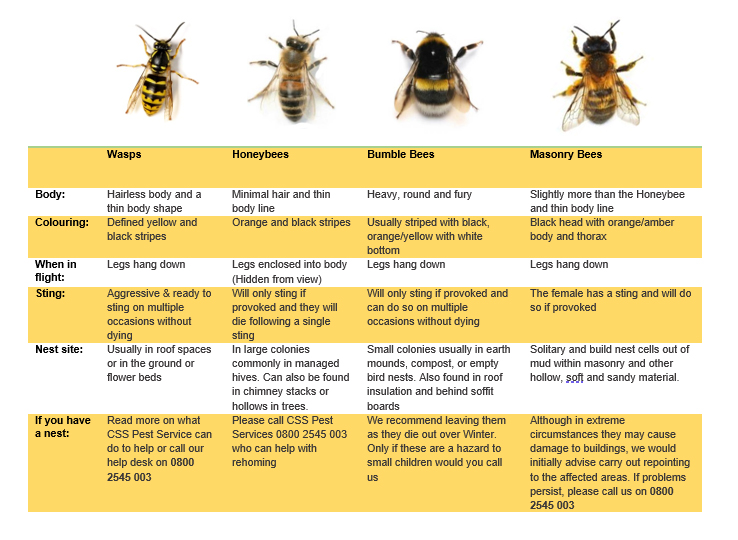
Many people think there is just one type of bee – the fury bumblebee we see in the garden hovering around the flowers in our gardens. Honeybees or masonry/mortar bees can be mistaken for wasps and vice versa because of their similar shape and colour. However, if you look closely, they are in fact as different in appearance as they are in characteristics. In fact, there are 26 different bumblebee species in the UK and numerous species of bees. From honeybees, to bumblebees, masonry/mortar bees and many more.
There is a helpful guide below which shows the differences in honeybees, masonry/mortar bees, bumblebees and wasps.